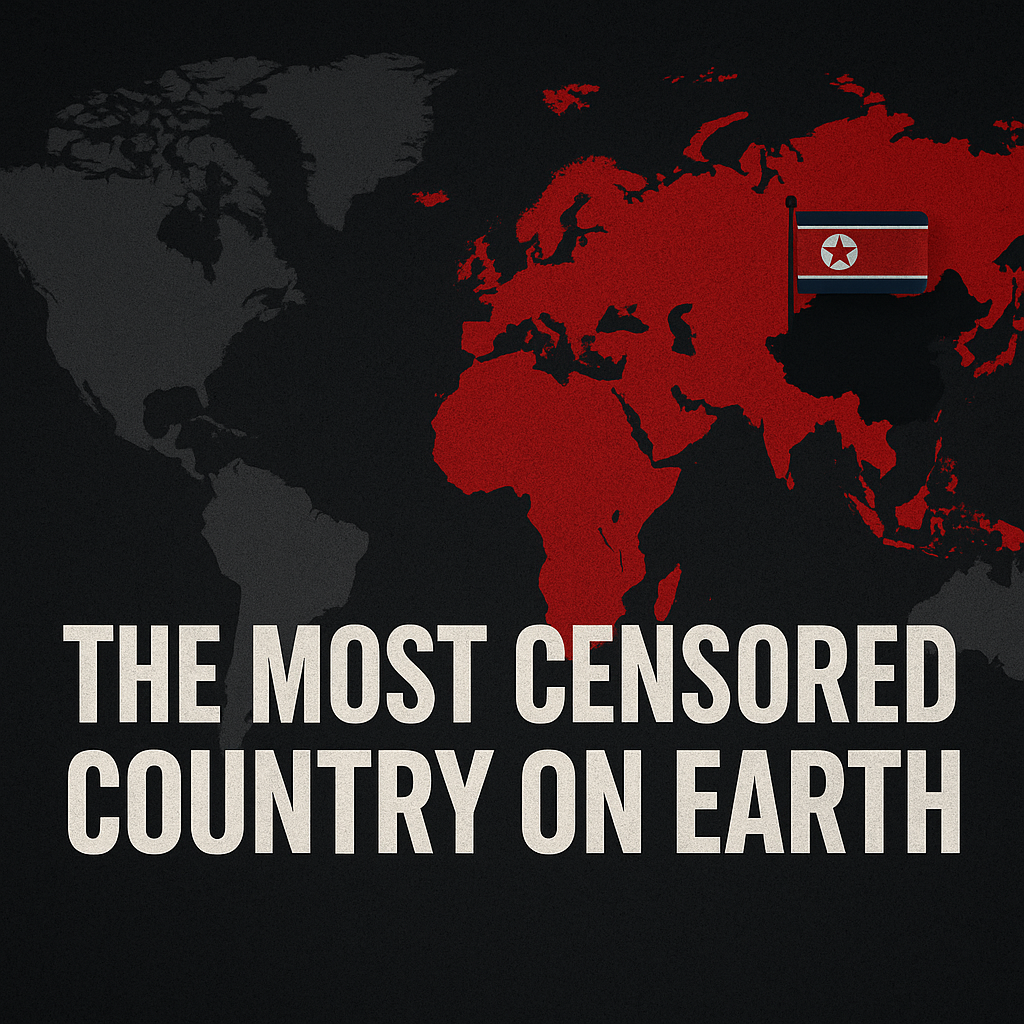
Welcome to North Korea, where your Wi-Fi password is “nice try” and your homepage is really a slideshow of propaganda. Don’t get too self-satisfied, though—if you think that censorship is merely a North Korean fever dream, you’re already behind.
Let’s talk about the global scoreboard of internet lockdowns, and why one particular nation does not just block websites—no, they atomize the entire concept of the internet into a black hole. And, spoiler alert: you might be nearer to digital dictatorship than you think.
North Korea: The Internet Is a Lie They Don’t Even Tell
Most countries censor websites. North Korea? They censor the entire internet. What you’re left with is Kwangmyong, a national intranet that’s about as open as a bank vault during a zombie apocalypse. It’s a wall of impenetrable hamster wheel of pre-filtered propaganda, edifying fluff, and no way to get to the actual outside world.
Forget Google. Forget Facebook. Forget even clicking a link and finding out something new. The average North Korean has no concept of the internet. Not like we do.
This isn’t just censorship. This is state-sponsored denial. And it works—because it’s not just about managing access. It’s about managing what is real.
China: The Surveillance Capital of the Internet
You knew they’d show up.
The Great Firewall of China is the most sophisticated censorship machine ever built. It doesn’t just block sites like YouTube, Instagram, and Wikipedia—it reprograms perception. Search for “Tiananmen Square” and you’ll get dancing cartoons. Mention “Winnie the Pooh” in the wrong tone, and your post disappears faster than a dissident on election day.
China’s digital control goes deeper than blocks:
- AI moderation 24/7
- Real-name registration for internet users
- Mass public surveillance through biometrics
- Reward and punishment scoring systems
It’s censorship as an ecosystem. And it’s spreading—because governments around the world are watching Beijing and taking notes.
Iran: Where the Web Fights Back
The Iranian regime engages in whack-a-mole with online freedom. Block a site, spark a protest. Block a service, spawn a dozen others.
When there is political instability, the regime does not just censor websites—they cut off the internet entirely. No signal, no social media, no voice to the world outside. It’s an electronic blackout, used to discourage disobedience and extinguish momentum.
Iran’s censorship is unique because the people fight it, openly. Every block is met with mirror sites, evasions, black market SIMs, and street-level info-war.
It’s a cyber war for the modern era—except that one faction has tanks, and the other has Telegram.
Russia: Censorship Dressed Like Patriotism
Censorship in Russia does not yell—it whines. It poses as defense. National values. Cybersecurity. “Why do you need Western propaganda in the first place?”
Since the invasion of Ukraine, it’s gone full-on Black Mirror. Foreign media? Blocked. Independent reporting? Branded as “foreign agents.” Social media? Downgraded, throttled, or flat-out banned.
Russia’s strategy? Block information, of course—pour noise onto the web. State-sponsored influencers, troll factories vomiting mayhem on an industrial scale. It’s not just censorship. It’s cognitive overload.
You can no longer tell what’s true and what’s not—and that’s the point.
India: The Democratic Censor You Didn’t See Coming
India is never far behind in reminding the world it is the largest democracy in the world. What it doesn’t proudly claim? It’s the world champion at shutting down the internet.
Yeah. More than Iran. More than China.
In the cause of “public safety,” the government triggers the kill switch in Kashmir, Rajasthan, Assam—you name it. Social media cutoffs, news blackouts, even throttling broadband across entire regions.
The reason is always national security. But when journalists, activists, and farmers are being spooked digitally, it’s hard to swallow the freedom-loving spin.
So… Who’s the Worst?
Technically? North Korea.
Realistically? China.
Surprisingly? Maybe your own country.
Because here’s the thing: censorship doesn’t always show up in goose-stepping uniforms. Sometimes it shows up dressed in a suit. Or as the CEO of a tech company. Or with a flag carrying your favorite color.
It starts withfiltered pornography. Then it’s “hazardous content.” Then “misinformation.” And before you know it, entire conversations disappear. Not because they’re wrong, but because they’re inconvenient.
Censorship Isn’t Coming. It’s Here.
The idea that “bad countries” alone censor citizens? Cute. But dangerous.
Blocked pages are no longer the norm. They’re the standard. Whether a dictator silencing Wikipedia or a Silicon Valley website excluding opinions it does not like, the web is being chopped and diced, watered down, and force-fed to you in bite-sized pre-approval.
The more you accept it, the bigger it gets.