You Didn’t Read the Fine Print. That’s the Point.
Every app. Every site. Every damn update.
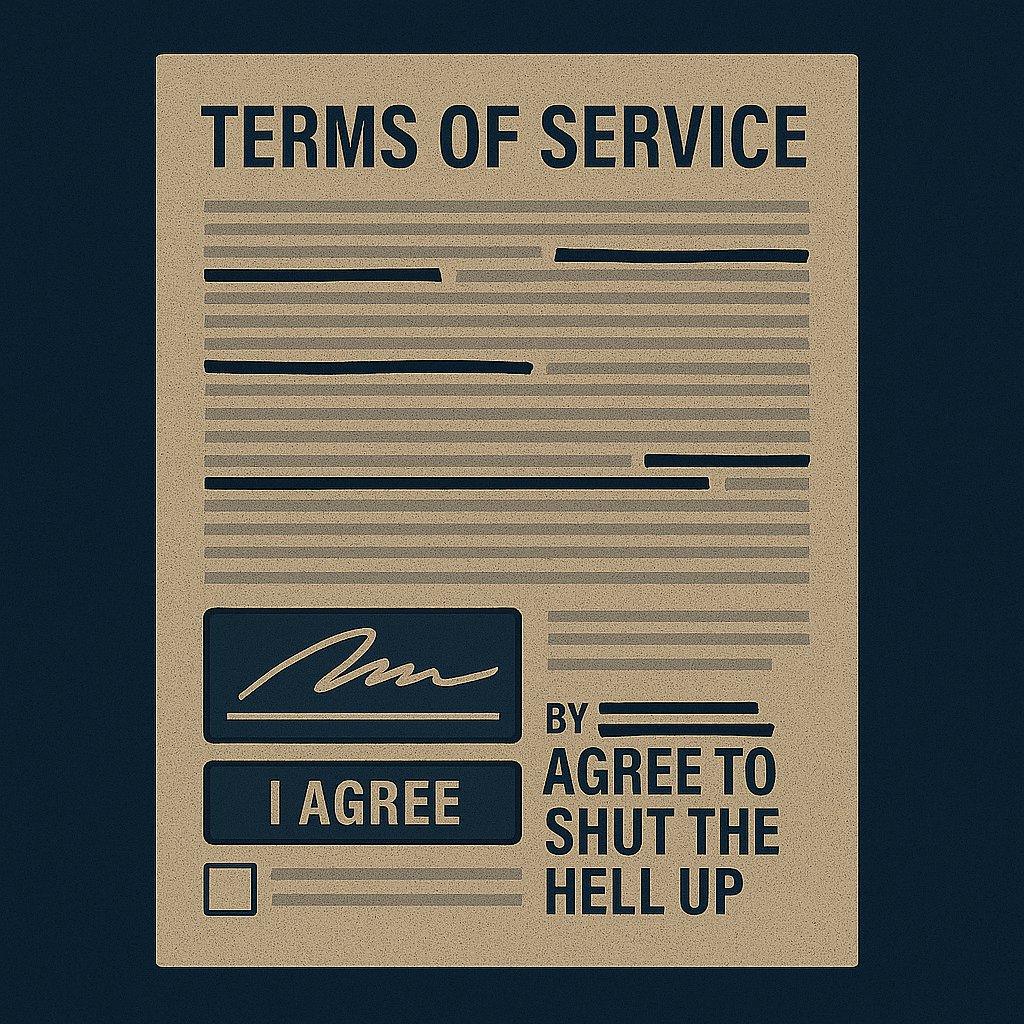
“By continuing, you agree to our Terms of Service.”
You click accept. Scroll. Post. Share.
Until one day, you’re locked out, flagged, throttled, or deleted.
What happened?
You violated the rules.
The invisible, evolving, conveniently vague rules.
Welcome to the era of TOS tyranny—where censorship doesn’t come from courts or cops, but from some uncontactable Trust & Safety team in a WeWork office. You didn’t break the law. You just broke the vibe.
The Rise of Terms-as-Censorship
Let’s get real: Terms of Service aren’t policies.
They’re control mechanisms dressed up in lawyer-speak.
They’re:
- Unilateral (you don’t negotiate, you submit)
- Dynamic (they change without notice)
- Ambiguous (intentionally vague to allow maximum enforcement leeway)
- Shielded (platforms can hide behind them to justify any action)
Most TOS documents boil down to one chilling sentence:
“We can remove or restrict anything, for any reason, at any time, and we don’t have to tell you why.”
And somehow… we agree to this.
“Violations” That Aren’t Violations
Your post didn’t incite hate.
Your comment wasn’t violent.
Your content wasn’t illegal.
But it felt wrong to someone—or worse, to something (hello, AI moderation).
Common excuses for takedowns:
- “Violates community standards”
- “Harms brand safety”
- “Contains potentially sensitive material”
- “Misinformation flagged by third-party checkers”
- “Promotes unsafe behavior” (like, say… protesting?)
They don’t need proof.
Just plausible deniability.
The Moderation Black Box
Ever tried appealing a takedown?
- There’s no human to talk to.
- No clear explanation.
- No consistent enforcement.
Sometimes identical content stays up on one account and gets deleted on another.
Why? Nobody knows. The algorithm is god.
And the only thing more opaque than the rules… is the enforcement.
TOS = The Ultimate Legal Loophole
This isn’t just sloppy policy. It’s deliberate strategy.
TOS lets platforms:
- Avoid lawsuits: You agreed, remember?
- Evade political accountability: “We’re a private company.”
- Silence dissent: Without touching actual laws.
- Curate narratives: By boosting some content and ghosting others.
They don’t need government orders.
They pre-banned the stuff governments might complain about.
The Global Trap
This isn’t just a Western thing. In authoritarian regimes, TOS is the censorship middleman.
Governments apply pressure. Platforms update guidelines.
The result?
- LGBTQ+ content gets labeled “adult”
- Political activism becomes “coordinated inauthentic behavior”
- Dissent is “against platform integrity”
No dictator needs to call in a takedown order.
The platforms do it themselves.
Preemptively.
So What Can You Do?
You read the fine print. You accept the power imbalance.
But you don’t have to roll over.
Here’s what helps:
- Mirror your content across platforms
- Support decentralized or open-source media spaces
- Push back when takedowns happen—publicly
- Screenshot everything (receipts matter)
- Call out vagueness—force them to clarify
Because if we don’t challenge TOS as censorship, we normalize a system where your rights expire with your login session.